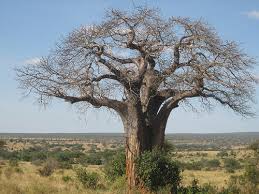
In Africa’s dry forests the baobab tree (Adansonia digitata) towers over the landscape. According to legend, the baobab tree fell from the sky. That’s why today the baobab is often called the upside down tree.
Another legend says when the Baobab was planted by God, it kept walking, so God pulled it out of the earth and re-planted it upside down to stop it moving.
Take one look at their root-like crowns scattered haphazardly on the parched African landscape and it’s easy to see how these legends started.
But it was never this easy for Wermi Sougrinoma and his family in Ouahigouya, a small rural area in northern Burkina Faso. Their baobab trees didn’t fall out of the sky.
Wermi Sougrinoma and his father toiled hard and long to establish a baobab plantation around their homestead, although they should never have needed to. Ouahigouya was once home to lots of baobab trees, but unsustainable harvesting by local communities soon brought about their demise.
Wermi Sougrinoma remembers seeing people actually fighting for the last remaining leaves of the last remaining baobab tree. He seized the opportunity to improve and protect his family’s baobab trees to supply leaves - an important condiment to add to relish.
By carefully planting Boabab seeds the family has managed to grow a healthy stand of 25-year old trees on two hectares. One of the challenges of growing baobab trees is getting the hard seeds to germinate. Fortunately for the people of Ouahigouya, the termites feed on the seed-coat, which allows water uptake and subsequent germination.
Wermi Sougrinoma and his family harvest the young and tender leaves for sale to neighbours and at nearby markets. In one large section of the plantation, the trees are still young enough to allow intercropping with millet or ground-nuts, which are important crops in dry, sandy parts of Africa.
Once the trees mature, they will become a veritable supermarket. The mature baobab produces a tartaric-rich fruit that can be used as a tonic. The leaves and flowers can be combined into a relish or specially prepared for medicinal purposes to treat a plethora of diseases. And the bark can be used to make masks, hats, baskets and other handicrafts.
The Sougrinomas are very mindful of how their baobabs increasing girth and crowns can affect their other farming activities. The trees need to be planted very carefully to prevent too much shade falling on other crops and to have room for the trunk to expand without taking up important cropping land. Such long term planning guarantees the family will reap a rich harvest of marketable leaves for many years to come.
Of course, it is not an easy road. When the Sougrinomas' trees reached three years of age, the leaves were attacked by worms and the family had to spray an expensive insecticide costing about US $5.50 per small bottle.
The key question from a livelihood perspective is how much the family gets from selling the leaves? Sougrinoma says although the income from selling baobab leaves is lower than from selling millet and peanuts, the income is very handy during the non-crop season and during drought periods.
The family also derives some sense of economic stability from their baobab investment. By investing in tree planting and management, the family has the added advantage of long-term tenure security.
The Government of Burkina Faso, through its land tenure regulations and its large national soil management programme, is encouraging land management practices like those used by the Sougrinoma family to restore degraded lands. By practicing good land management, a family can be guaranteed private ownership and use of the piece of land that has been rehabilitated.
Ouahigouya’s baobab experience shows that even in dry areas, tree planting still remains an option and that rural people are very adaptable and innovative.